
Read Time (minutes)
5

Resistance Bands and Home Exercise Programs
Building strength doesn't require expensive equipment or a gym membership. Many of the most effective rehabilitation exercises can be performed safely at home using your own body weight or simple resistance bands. The key to success isn't having the latest equipment — it's creating a routine that is practical, progressive and easy to maintain.
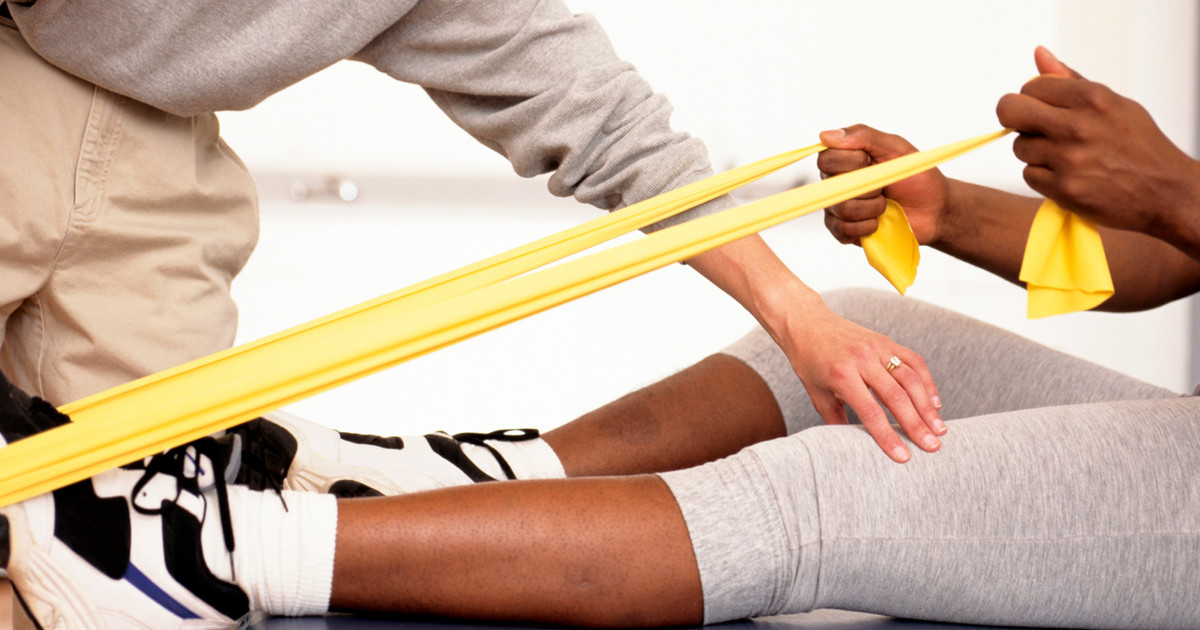
When people decide they want to become stronger, many assume the first step is joining a gym. For some people that works well. For others, the cost, travel, unfamiliar equipment, or simply walking through the front door can become barriers that prevent them from getting started.
The good news is that strength does not depend on where you exercise. It depends on whether your muscles are regularly challenged in a safe and progressive way. Many people living with persistent pain achieve excellent results without ever setting foot in a gym, with an exercise program that fits around their life, uses simple equipment at home, and focuses on movements that make everyday activities easier.
Why resistance bands work so well
Resistance bands have become one of the most commonly prescribed pieces of rehabilitation equipment, and for good reason. They are inexpensive, portable, and suitable for almost every level of strength. Unlike traditional weights, the resistance changes as the band stretches, letting muscles work throughout the movement while placing relatively little stress on painful joints. Bands are available in different strengths, making it easy to gradually increase the challenge as your body adapts. For many people, they provide an ideal balance between simplicity and effectiveness.
Home is often the best place to begin
Starting an exercise program at home removes many of the barriers that prevent people from exercising consistently. There is no travel time, no waiting for equipment, and no concern about what other people might think. Instead, you can focus on learning good technique, becoming familiar with the exercises, and gradually building confidence in your own environment. For many participants, this creates the consistency that is essential for long-term progress, and once exercise becomes part of your daily routine, it often feels much easier to continue.
Practise movements that matter
The most effective home exercise programs do not try to imitate complex gym workouts. Instead, they focus on strengthening the movements you use every day: standing up from a chair, stepping onto a stair, reaching overhead, lifting an object safely from a bench, walking with good posture. These exercises directly support the activities that matter most in everyday life, and rather than training muscles in isolation, they help your body work more efficiently as a whole.
Progress doesn't require more equipment
It is easy to think that becoming stronger means constantly buying heavier weights or more specialised equipment. In reality, there are many ways to increase the challenge of an exercise: you might perform one or two extra repetitions, use a slightly stronger resistance band, slow the movement down, improve your technique, or simply complete the same exercise with greater confidence than you did a month ago. Progress is measured by adaptation, not by how much equipment you own.
Keep it simple
The best exercise program is rarely the most complicated. A small number of well-chosen exercises performed consistently will usually produce better results than a large collection of exercises that are difficult to remember or impossible to maintain. Your healthcare team can help design a program that matches your goals, your current ability, and the activities most important in your life. Over time, those simple exercises become something much bigger: part of the routine that keeps you strong, independent and capable of continuing to do the things you value.
If a gym has ever been a barrier for you, cost, travel, or how you might feel there, would a few simple exercises at home remove that barrier? What would make starting at home feel easy?
KEY TAKEAWAY
Effective strengthening can be achieved at home with simple equipment, and resistance bands offer a safe, versatile and affordable way to build strength. Home programs should focus on movements that support everyday function, progress comes from gradual increases in challenge rather than more equipment, and simple, consistent routines are the foundation of long-term success.
Where to next
Book a Free Navigation Call
Explore Coaching
Clinician Consultation


Authour
Pain Education and Management (PEM)
Last Evidence Review
2 July 2026
Pain Pal provides educational support only and does not replace medical advice, diagnosis or treatment. Always consult your healthcare professional regarding your individual circumstances. In an emergency, call 000.